Thursday, 16 February 2017

Wednesday, 15 February 2017
How to create a blog
How To Start A Blog
Step-By-Step Guide (Updated 20 Z)
If you’ve ever wondered how to start a blog, you’re in luck because that’s exactly what I’m going to show you today.
20 minutes is all you need, and you DON’T need any knowledge of HTML, coding or graphics design.
I’ll walk you through the whole process in a moment, but first, let me tell you my story…
4 years ago, I didn’t know the slightest thing about creating a blog. Greatly excited by the prospect of starting a blog of my own, I went ahead to register my first domain name.
Then, I became confused. I didn’t know what to do next. I struggled for 18 days, invested time and energy to understand the new “blog,” checking Google for stuff like “how to create blog” without grasping anything.
Everything I found seemed technical. I got frustrated.
In despair, I abandoned the new domain name for… 6 months.
Then, I went back to it, having eventually learnt that I needed not just a domain name but also a hosting account to open a blog.
So… I started my first blog, and struggled with each step because I had no one to guide me. You can set up a blog in 20 minutes, but it took me 6 months the first time out.
Over the years, I’ve learnt a lot about blogging and I’ve set up many successful blogs for myself. I’ve also showed thousands of people how to create a blog of their own, by themselves. I know what best practices to use and the mistakes to avoid.
I want to help you avoid all the pains I endured.
Benjamin Franklin said, and true are his words:
Experience is a hard master, but fools will have no other.
So, learn from history, not experience. I’ll tell you how to make a blog that’ll succeed, so you can forget everything else.
Just follow the simple steps below, and your blog could be ready in 20 minutes.
Please note, if you get stuck while making your blog, please feel free to get in touch via Richard@HowToStartABlogOnline.net and I’ll be glad to help you out for free.
How to start a blog in 7 steps
1. Know WHY you want to start a blog
2. Decide WHAT your blog will focus on
3. Choose a blogging platform
4. Choose a web host
5. Set up your site using Host Gator.
6. Install wordpress
7. Login to your new blog and start blogging
2. Decide WHAT your blog will focus on
3. Choose a blogging platform
4. Choose a web host
5. Set up your site using Host Gator.
6. Install wordpress
7. Login to your new blog and start blogging
Step 1: Know WHY you want to start a blog
When you know your destination, finding your direction becomes easier, right?
People start blogs for different reasons. Today, blogging is a great way to:
- Become a better person. Blogging helps you think clearer, communicate with intentionality and build your creative flair.
- Improve your writing. Writing proficiency comes with regular practice and starting a blog helps you write regularly
- Make your voice heard. Gone are the days when only powerful politicians and wealthy businessmen could air their views. Now, you, too, can!
- Make a difference. You want to help people take control of their personal finance? Start your own blog. You wish people would exercise more, take healthier meals and rest better? Start a blog.
- Get published. The world is changing, and traditional publishers are falling into irrelevance. Smart authors now make a blog, build a loyal audience and publish their works. This approach works always.
- Make money. It takes time and commitment but people make real money from blogs. I’ve made tens of thousands of dollars myself from blogging. And many folks I’ve taught how to open a blog are doing fine too.
If you’re still undecided, see: 34 Reasons Why You Should Start A Blog. (opens in a new tab)
You can start a cool blog for any or all of the above purposes. Just use this simple guide, and you’ll see how easy it is.
Step 2: Decide WHAT your blog will focus on
People start different classes of blogs.
Travel blogs. Vegetarian blogs. Romance blogs. Writing blogs. Marketing blogs. Political blogs. Religion blogs. Fashion blogs. Photography blogs.
So… what type of blog should you start?
What will be the focus or theme of your blog? This theme is called a niche –– and you should have one.
The best is to choose a niche you’re passionate about. Blogging is to be enjoyed. You know, there’s fulfillment in connecting with others and providing helpful information. You’ll experience this joy, and be able to do it for long, if you’re passionate about what you blog about.
When I finally launched my first blog, I found I was really passionate about writing and publishing. So I made that my niche and was able to connect with, learn from and impact many nice people. I even made money from it. I was fulfilled.
What are your hobbies?
What do you feel happy doing? What are you always excited to talk about to your friends?
Is it fashion, technology, entrepreneurship, leadership, food, traveling, relationship, movies or fiction? That’s probably what you should be blogging about. If you’re passionate about it, you can keep sharing useful information about it.
Create a blog today, and talk about what you love, what you know, and what you’re learning. It’s easy, and you CAN do it.
Step 3: Decide WHICH of the blogging platforms you’ll use
The question, “How do you start a blog?” has many alternative answers. You can do it on blogging platforms like:
- Blogger: e.g. yourfashionguy.blogspot.com
- Hosted WordPress: e.g. yourfashionguy.wordpress.com
- Self-Hosted WordPress: e.g. yourfashionguy.com
The first two options are free. But they’re also clumsy and ugly, don’t you think?
If your interest is to start a blog for business, a self-hosted WordPress blog is more professional. If it’s to do it for a cause or as a hobby, a self-hosted WordPress blog is more elegant.
The free blogging platforms aren’t really free.
They come with TONS of annoying limitations that just enslave you. Here’s 5 of them:
Limit #1: if you think the companies allowing you to create a blog on their blogging platforms for free do so because they love you, you’re wrong. They only do so to make money off of you. That’s why they put up adverts on your blog and ask you to pay to enjoy upgrades. Go for a self-hosted blog so you won’t be a wheel in a car working to make another company rich.
Limit #2: you’re not allowed to do affiliate marketing on free blogs. Some of them further prohibit Google Adsense and other cool ways to make money blogging. That’s not how to start a blog rightly.
Limit #3: you can’t use any of the thousands of amazing plugins and themes available to a self-hosted blog. After making a blog, plugins help you extend the functionality of the blog, the same way apps extend the functionality of a phone. Imagine having a phone without being able to install and use apps. Is it cool to live in a house you’re prohibited from painting and designing? If it’s not, then it sucks to have a blog without being able to use a theme on it.
Limit #4: you can’t use a custom email like John@YourFashionGuy.com. That’s not cool. You deserve something better.
Limit #5: on free blogging platforms, your blog can be deleted at anytime if the company’s server mistakes your blog for a spam, or if you accidentally violate their rules. And guess what – you have no remedy if that happens.
So the smart choice is to go with a self-hosted blog.
How much does a self-hosted blog cost?
Turns out, not much.
What you’ll pay to set up your blog is less than a movie ticket. First, you’ll need a domain name – usually sold for $15 but I’ll tell you how to grab it for FREE.
Second, you’ll need a hosting account which costs less than $72 for the first year.
I’ll show you how easy both steps are in a moment.
Step 4: Decide which web host to use
In my many years of creating and managing blogs, I’ve learnt from bitter experiences that NOT many web hosts are awesome. I’ve used some big name web hosts in the past, and while they make sweet promises, their services are not really that good.
- Their servers often had issues and make my sites load slowly and go down too often (this gave me nightmares in day time)
- Their customer care agents were often too lazy, clueless or too busy with other things to properly offer a help when I needed it
- They do some aggressive, spammy marketing like installing plugins or placing their links on my websites without my consent
Why HostGator is reliable
#1: they provide 24/7 customer support through chat, phone, or email and in my experience, their customer service reps are helpful, polite and professional.
#2: they guarantee and provide an amazing server uptime of 99.9%. Very few web hosts can match that feat.
#3: they give you SSL – if you don’t have SSL (https://) for your site then you could be losing traffic from google.
#4: their service is extremely easy to use, and they have an option that is specifically tailored to WordPress. Whether you’re an expert or a non-geek, they’ll make your experience memorable.
#5: they offer unlimited email accounts and websites.
#6: they are giving howtostartablogonline.net readers a 30% discount by using the coupon code htsabo.
Disclosure: I am an affiliate of HostGator and if you sign up through any of the links on this page, I may get a little commission (at no extra cost to you). But this didn’t influence my recommendation, because all hosting services have similar programs. I recommend HostGator because I have personal experiences with them and honestly believe they offer amazing quality.
#7: they have a 45 Day No Risk Guarantee.
Step 5: Go to www.HostGator.com and click start your WordPress blog
First, go to HostGator and click “Start Your WordPress Blog Now” for hosting.
On the next page, enter the domain name you want to register for free, choose the domain extension (I’d go with “.com“) and Host Gator will automatically let you know if its taken. Then they will ask you if you want to add other extensions. I recommend at least picking up the .net and .org if they are available.
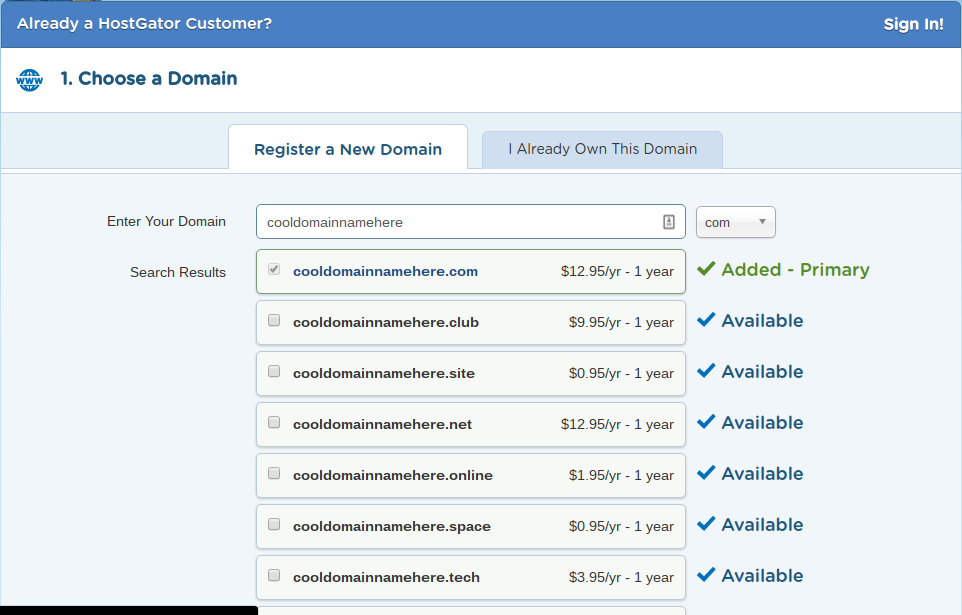
On the next page, choose your hosting plan. I recommend the “Hatchling Plan” because this is probably your first blog. If you plan to get more, you can always upgrade later.
Next you will create a login and security pin. Be sure to take a minute and note these items somewhere so you can access them later.
The 3rd step on this page is to enter your billing information.
4th is the recommended addons. I recommend you get the HackAlert monitoring but the other two items are not as important.
Review your details and at the bottom of the page be sure to check the box indicating you agree to the terms (after you have read them of coarse)
Next be sure you need to enter the code htsabo in the Enter a Coupon Code section for 50% OFF! and click the “Validate” button.

Finally click “Check Out Now“
The next page shows that your order is successful.
Congratulations! That’s all it takes to create a hosting account with Host Gator.
Step 6: Setting Up Your WordPress Site on Host Gator
To set up your wordpress site you will need to login to your cpanel. Just head over to your welcome email from hostgator and find the cpanel login details and beside the text “Your Control Panel” you will see the url to login:
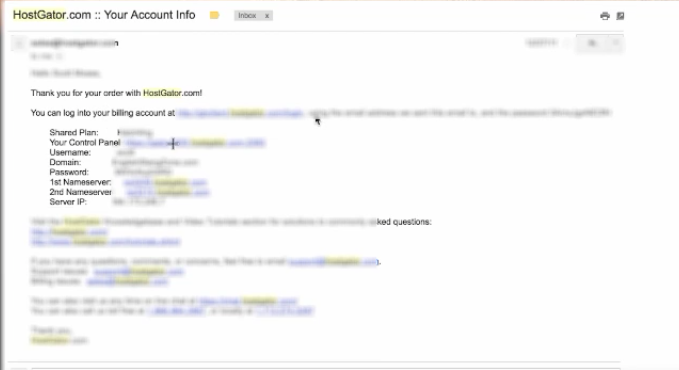
Go to the URL indicated and login. Next click “Get Started with WordPress” under the Special Offers section.
Next, click the “Install” button. And follow the prompts to install wordpress on your new domain. Be sure to use your real email address so you can get your wordpress user name and password.
That is all the settings you need to change, finally click install at the bottom. The installer will take a few minutes and finally you will see the success screen.
Now your wordpress site is up and running Great Job!
Step 7: Login to your new blog and start blogging
Open a new browser tab and go to “http://YourNewBlog.com/wp-admin” (replace “YourNewBlog.com” with your blog domain name). Login with the username and password you copied in step 5 above.
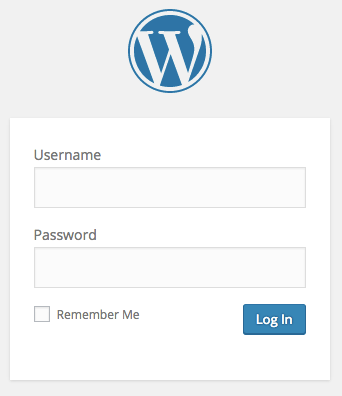
You’ll see your blog dashboard. This is the “back side” of your website from where you set everything that your readers see on the “front side”.
Look to the left of your dashboard and you’ll see menus.
If you want to publish a new post on your blog right away, that’s totally fine. The post doesn’t have to be perfect; it just has to be published, to get you started. So go ahead and do it.
Hover the mouse on “Posts” and click “Add New” from the sub-menus that pop out.
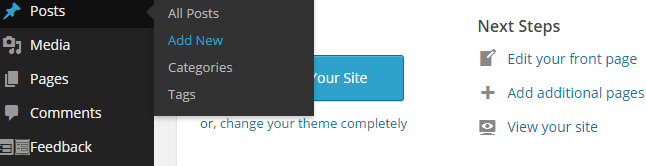
Add the title of your post in the first tab and the content in the second tab.
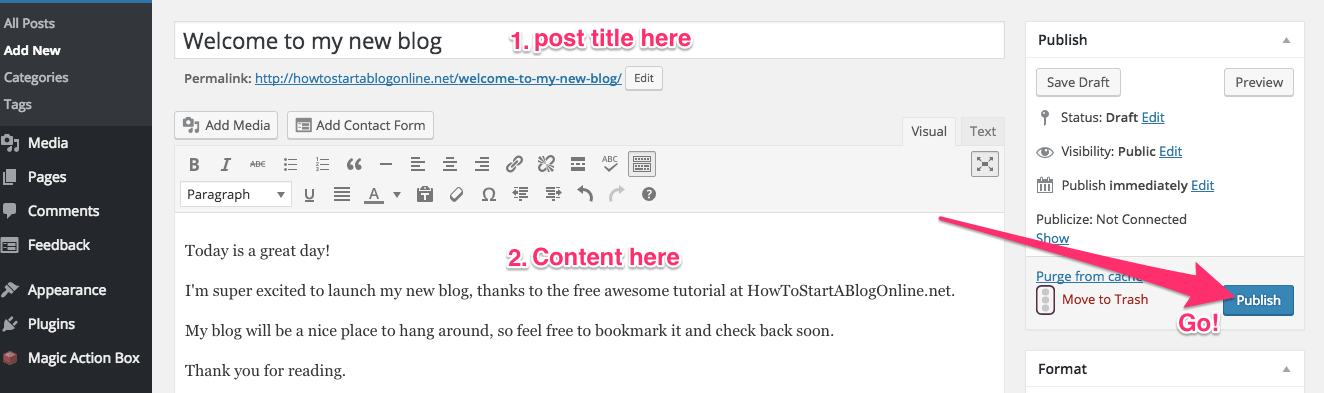
Hit “Publish”.
When the next page loads, click “View post” to see how your new post appears to your readers.
How to operate a computer
Level of difficulty: Beginner
This procedure attempts to outline the basics in operating a computer system based on the assumption that it is running under the Microsoft Windows XP Operating System platform with normal components such as CD or DVD drive, Network Interface Card, and video card installed in the CPU. The steps outlined are formatted in such a way that it is applicable to the two most common computer system architectures: the desktop and the laptop. Essentially, a desktop computer is just what its name suggests. It is big enough to sit on the desk and is considered as the most common type of computer system. A laptop or sometimes referred to as a “notebook” is a smaller and more mobile version of the desktop machine and is normally used in the same manner but with relatively lower power requirements.
Materials Needed:
This procedure attempts to outline the basics in operating a computer system based on the assumption that it is running under the Microsoft Windows XP Operating System platform with normal components such as CD or DVD drive, Network Interface Card, and video card installed in the CPU. The steps outlined are formatted in such a way that it is applicable to the two most common computer system architectures: the desktop and the laptop. Essentially, a desktop computer is just what its name suggests. It is big enough to sit on the desk and is considered as the most common type of computer system. A laptop or sometimes referred to as a “notebook” is a smaller and more mobile version of the desktop machine and is normally used in the same manner but with relatively lower power requirements.
Materials Needed:
- CPU
- keyboard
- monitor
- mouse
- speakers
- printer
- Operating System
- keyboard
- monitor
- mouse
- speakers
- printer
- Operating System
Step 1
Prior to powering up the computer system, make sure that the power cord is firmly connected to the back panel of the CPU and is plugged into the wall socket.
Step 2
Check if the video cable is firmly screwed to the port of the video card with the other end connected to the back panel of the monitor.
Step 3
Make sure that both the keyboard and mouse pointing device are securely plugged to the back panel. Also, check if they are connected to the correct port by checking on the markings. Steps 1 to 3 are essentially easy to do because aside from the mouse and keyboard devices, other components can only be plugged into their proper ports preventing the novice user from interchanging them.
Step 4
When all connections are secure, start up the machine by pressing the power button normally located in the front panel of the CPU.
Step 5
Depending on the configuration of the machine, a username and password may be requested; otherwise, the Operating System may be loaded directly to display the desktop to the user.
Step 6
Other basic operations that can be done include adjusting monitor settings in Step 8. Installation and launching of software is outlined in Step 10. Navigation of the file system is detailed from Step 15.
Step 7
The proper way to shut down or turn off the computer system is by clicking on the 'Start' button and choosing the 'Turn Off Computer' option. This will display the options to 'Standby', 'Restart', or 'Turn Off' the machine.
Step 8
To adjust the monitor settings, right click on any blank portion of the desktop and select the 'Properties' option from the context menu.
Step 9
On the 'Display Properties' window, select the 'Settings' tab to adjust the resolution of the screen. The 'Themes' tab will allow the loading of pre-designed Windows themes. The 'Desktop' tab provides the way for changing the color of the desktop as well as the displayed wallpaper. The 'Appearance' tab provides the various options of changing the behavior of the windows, icons, and other elements of the platform, while the 'Screen Saver' tab shows the option to allow the monitor to go on standby or display animation.
Step 10
To extend the functionality of any computer system, software is normally installed into the local hard drive. A software installer may be through some media like a CD or DVD or from being downloaded from the Internet.
Step 11
For CD or DVD installers, insert the installation disk in the CD or DVD drive of the machine. This will be automatically read and launched by the Operating System.
Step 12
When the installation process is initiated, a new window will normally be displayed to the user. Majority of newer installers provide either a default or an advanced installation procedure. In most cases, simply click on the default process to allow the installer to complete the entire process with minimum user intervention.
Step 13
Upon completion of the installation process, a user may be prompted to reboot the machine. Follow the guide in Step 7 to accomplish this task.
Step 14
To launch the software, simply click on the 'Start' Menu, choose 'All Programs' and select from the menu the program intended to be run. An alternative to this process is to check if a shortcut link is created on the Desktop. Clicking this icon will also launch the associated program.
Subscribe to:
Comments (Atom)